A normal behaviour model learns how a healthy turbine relates wind, power, temperatures and commands. When the turbine stops behaving that way, the gap between what the model expects and what the turbine reports grows, and an adaptive threshold decides when that gap is a fault rather than noise. No fault labels are needed for training.
We use quantum machine learning for the normal behaviour model. Variational quantum circuits embedded in the LSTM gates (QLSTM) capture high-order interactions among SCADA variables in Hilbert space with few parameters, and the number of input variables sets the number of qubits.
QLSTM normal behaviour model
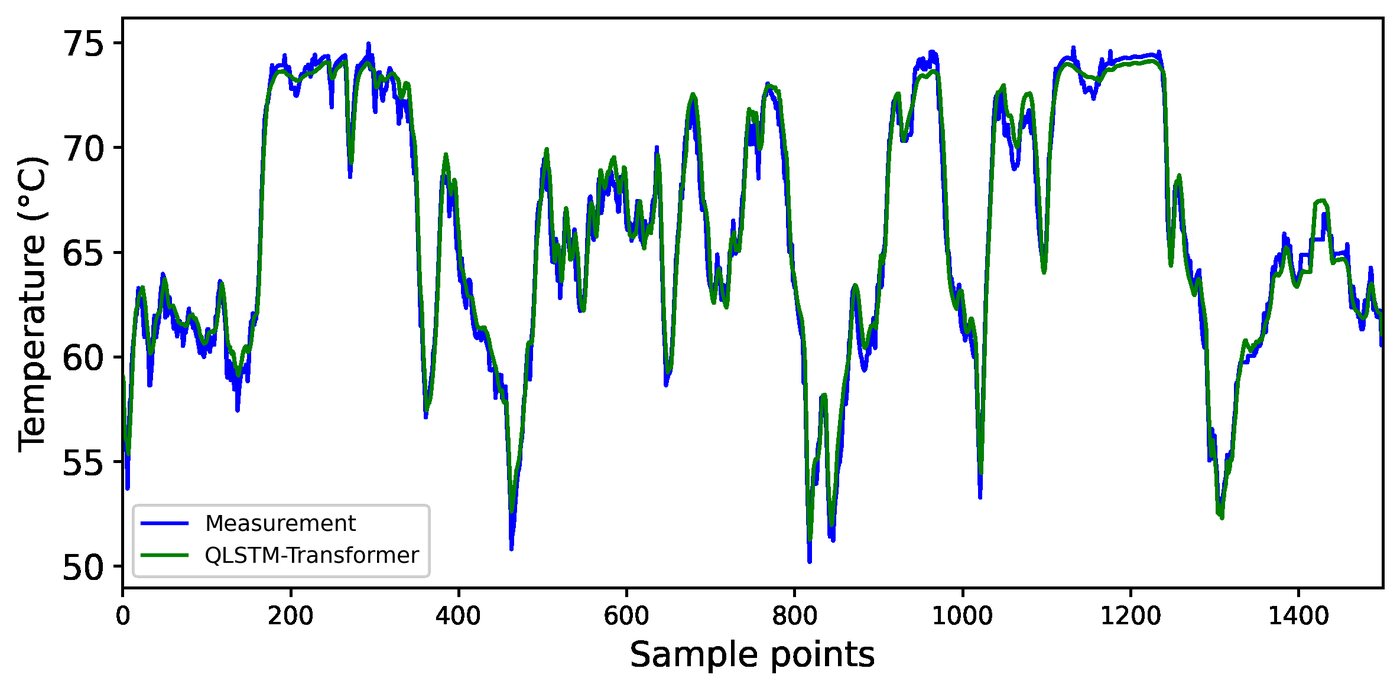
Zhang & Ma, ICAC 2025. Gearbox bearing temperature on a fault-free test set; faults flagged by a T-distribution residual threshold.
LSTM 0.9358
LSTM 2.278
QLSTM-Transformer with BISW thresholding
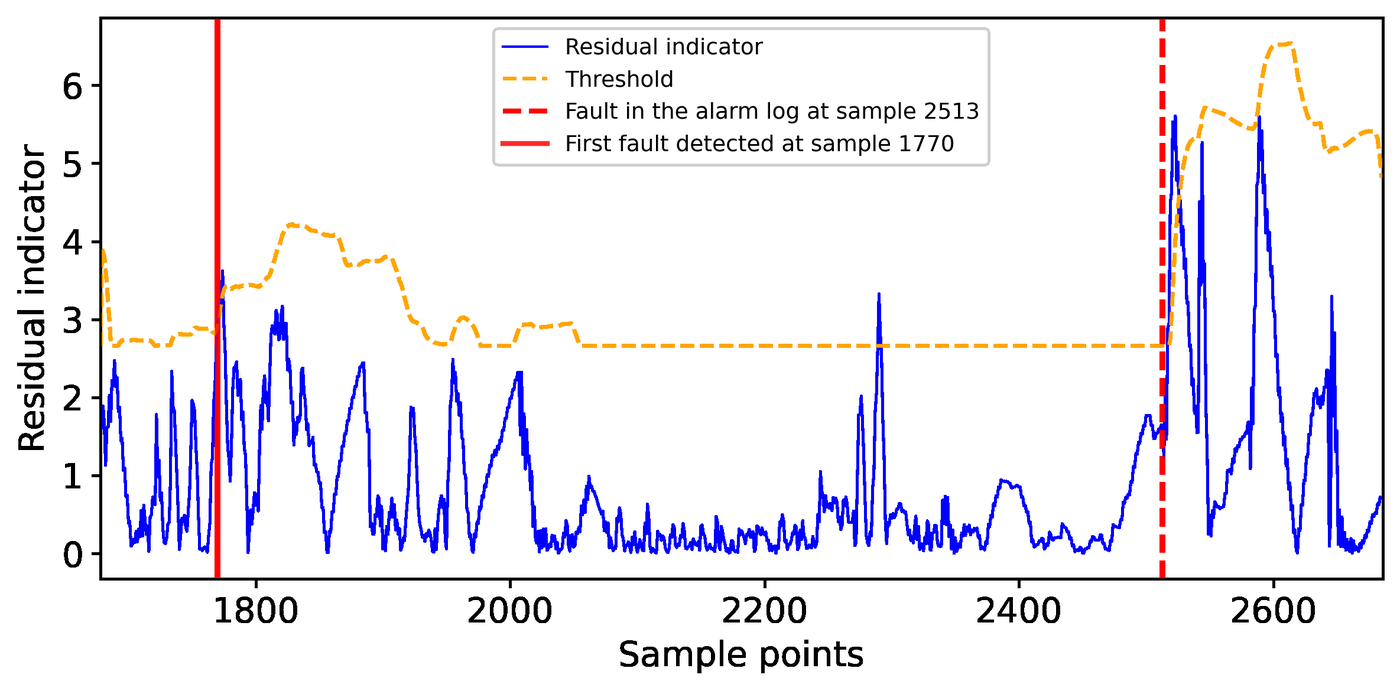
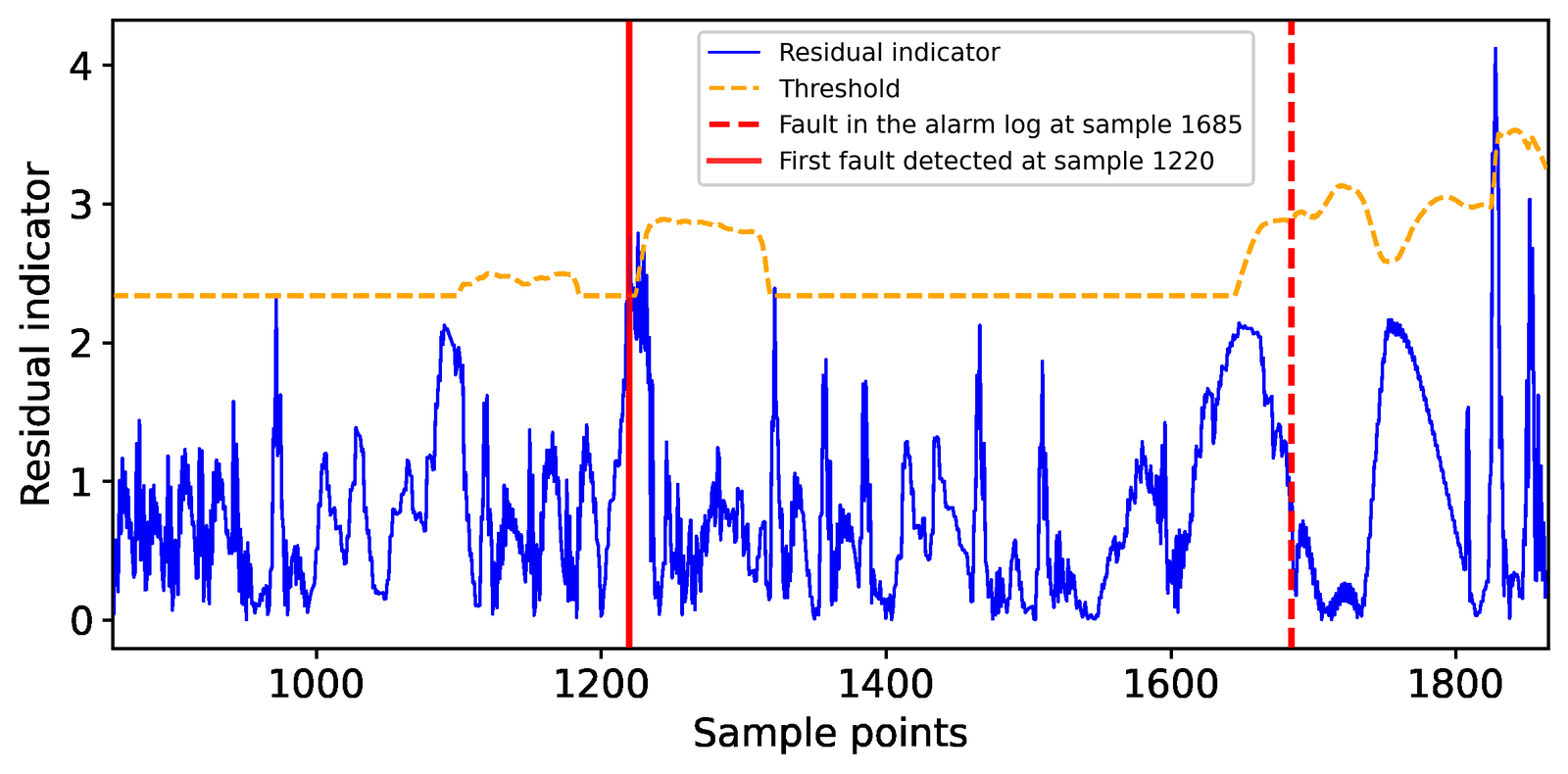
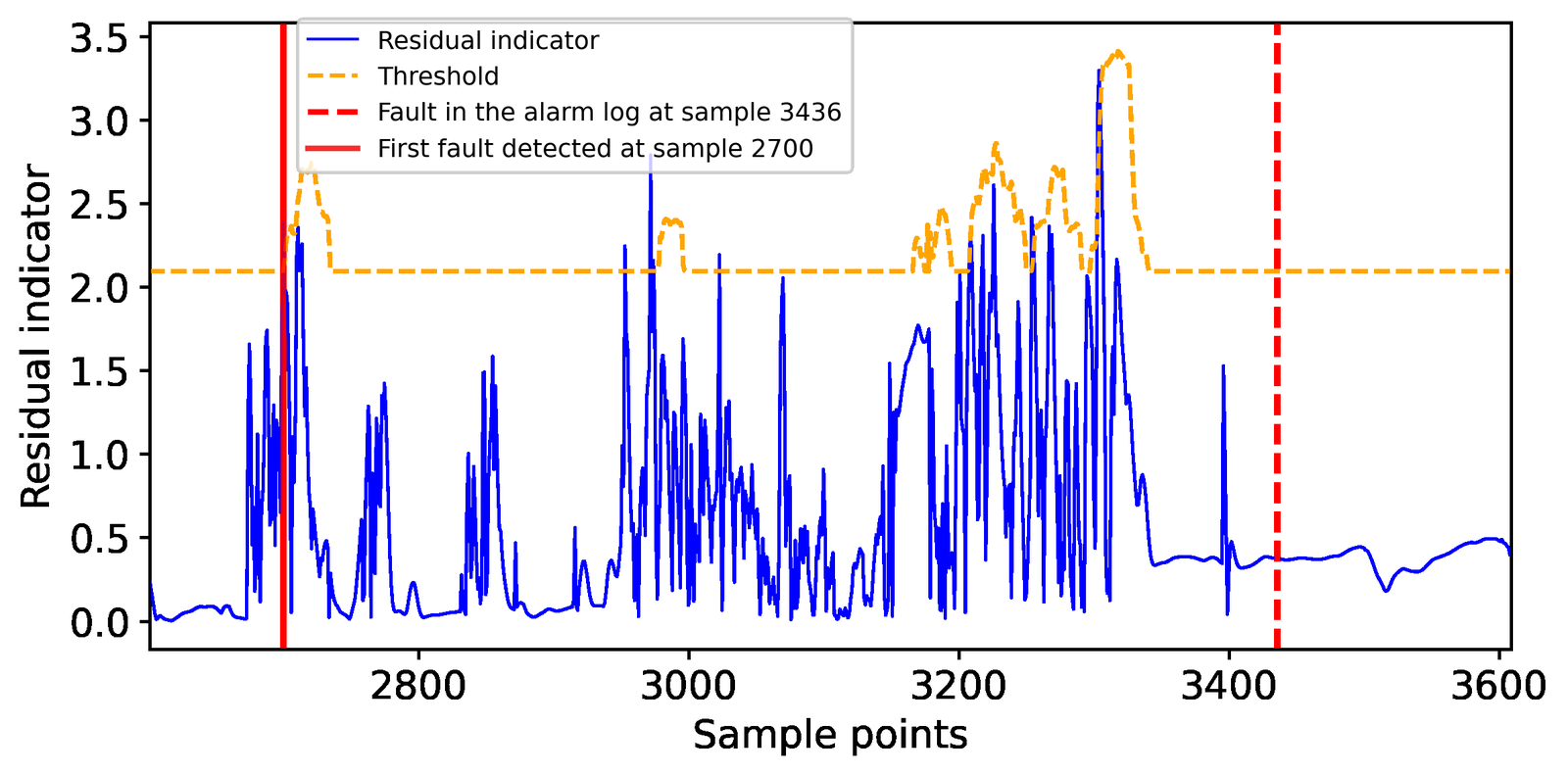
Zhang et al., Energy Conversion and Management: X, 2026. Three real faults: gearbox bearing overheating, generator winding overheating and pitch control failure. BISW combines Bayesian inference with a sliding window so the threshold follows both short-term variation and long-term trend in the residual.
gearbox bearing
generator winding
pitch control
on all three faults
| Model | Gearbox | Generator | Pitch | |||
|---|---|---|---|---|---|---|
| R² | RMSE | R² | RMSE | R² | RMSE | |
| QLSTM-Transformer | 0.9575 | 1.128 | 0.9518 | 1.076 | 0.9791 | 0.327 |
| LSTM-Transformer | 0.9468 | 1.390 | 0.9497 | 1.127 | 0.9675 | 0.368 |
| LSTM | 0.9377 | 1.460 | 0.9243 | 2.698 | 0.9516 | 0.420 |
| Transformer | 0.9375 | 1.629 | 0.9041 | 3.510 | 0.9534 | 0.416 |
| Model | Gearbox bearing | Generator winding | Pitch control | |||
|---|---|---|---|---|---|---|
| Hours | False alarm | Hours | False alarm | Hours | False alarm | |
| QLSTM-Transformer | 123.83 | No | 77.50 | No | 122.67 | No |
| LSTM-Transformer | 109.67 | No | 75.50 | No | 68.83 | No |
| LSTM | 92.33 | Yes | 32.50 | No | 121.00 | No |
| Transformer | 109.67 | Yes | 76.83 | No | 120.83 | No |
The paper also compares KDE and EWMA thresholds and the DIV and TSDT methods. QLSTM-Transformer-BISW gives the longest (or joint-longest) warning on all three faults while raising no false alarms.
Detection on the three faults
At fleet scale
In TurbineCore, a world model trained on confirmed-healthy periods plays the role of the normal behaviour model across whole wind farms, and its residual is the anomaly score.